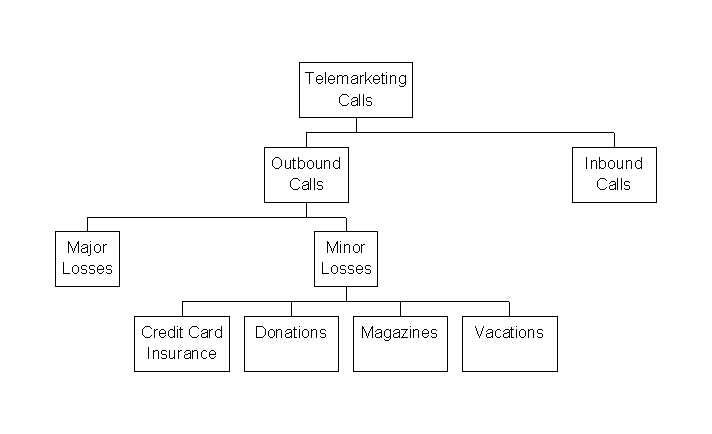
Telemarketing Fraud Where Losses Are Under $1000
"Where's the Check?" Scam
Aggressive scam artists often seek out vulnerable seniors who are suffering from memory loss. Then, sounding charming on the phone, they seek to gather as much information about their potential victim.
When they call back on the second day, they will ask questions based on the personal information gathered during the first call. If the senior can't recall the initial conversation, the fraudulent pitch, which can have several variations, begins:
"You sent us too much money," the caller insists. "We received your check for $1,200, but it should have only been $950. Tell you what. Send us a check for the lower amount, and we'll send your first check back to you."
"Our records indicate that you've paid $2,400 toward your total payment, leaving a balance of only $600. Let's make a check today to clear this up, and we can get your award out to you."
In both cases, no money had ever been previously sent. The victim will likely send the check out of guilt or embarrassment. The hook for the scam artist is the victim's poor memory which leads to the fraudulent action.
Even Buzzards Have a Conscience
Preying upon mourners over a recent death, or "vulture fraud", is one of the cruelest and lowest forms of swindling.
The con artist obtains information from death notices, then calls or visits members of a bereaved family, and attempts to collect sums of money for items which they maintain were purchased by the deceased before his death.
Sometimes they render bills when nothing is owed, or claim partial payment has been made by the deceased and attempt to collect the alleged balance.
Help Is On The Way
An African-American pastor received a collect call after 9 p.m. from an individual identifying himself as the Deacon Harrison of another city church. He claimed to have previously met the minister and frantically related that he and his family were stranded out of state, after experiencing car problems on a freeway.
The caller said that a state trooper had their car towed sixty miles to a small community where a mechanic repaired the car and presented a bill for $859. The family could only come up with $586.
The elaborate story included reports of racial discrimination, name-calling and intimidation by the local white law enforcement who supposedly threatened to force the family, traveling with a disabled mother, to walk back to the freeway sixty miles away.
The caller sobbed to the pastor that he had tried to call several deacons and members of his own church but none answered his calls. The phone was then passed to someone identifying himself as the sheriff. He told the minister to send the required $273 by Western Union to a particular woman who would verify its arrival.
The sheriff then would release the family in their car so that they could continue their trip. The sheriff added the threat that if the money was not delivered there would be trouble.
The driver, put back on, said he would phone back when he and his family had reached the freeway.
The pastor who was the target of the scam did as he was told but never heard from any of the people again. He was out the $273, plus Western Union charges.
Calls made the next morning to the names supplied by the caller revealed that the church deacons had never heard of the so-called Deacon Harrison. It had all been a clever plot by thieves, preying on the kindness of others.
Fluffing Your Pillow
Scam artists will call hotel guests in their rooms late at night, saying they are members of the hotel staff. Using some administrative pretext they ask guests for their credit card numbers.
Those guests tired and unwary enough to fall for the trick later find charges on their credit card statement for purchases they never made.
All-Star Idiot
A scam which targets managers and employees of local businesses is where a con artist phones you and holds himself out to be an airline pilot with a major airline. He claims to have season tickets to a major stadium or sporting event.
He says the tickets have been in his family for years, given as a corporate gift from an affluent regular customer, but as he's flying to Australia, he won't be able to use them.
The "pilot" says he wants to sell the tickets at face value and let someone enjoy the game or event. He asks, "Do you know anyone who would like to buy these six excellent seats for $750?"
This "airline pilot" is good at the con game. He uses his knowledge of local people to win the confidence of his targets, often calling a second time after he has obtained information about the targeted employee. Within two conversations, he's almost your best friend.
Once he has a buyer he says that another pilot "Captain Donald Prescott will be flying into town on a later flight. I can send the tickets with him! " "Just meet Flight 691, Don will be the last person off the plane, and he'll have the tickets."
He suggests setting up a question and password to be sure the wrong person doesn't get the tickets instead of you. "When you see the pilot, ask him about the tickets. He'll ask you, "What's the game?" You answer, "All-stars."
But, he says there's just one problem: "How can I get paid for the tickets? Unfortunately, I won't see "Captain Prescott" before I depart for Australia."
Then, he has a solution: "Just use a Money Gram! Wire me the $750 using the same question and password that you're going to use to get the tickets."
He uses this "question and password" method because he won't have to present any other identification when he picks up the wired money.
He has pulled similar cons successfully in cities across the United States. Once the money is wired it is lost. No tickets will be delivered.
The bottom line: never wire money to someone you don't know, and especially never fall for a con that asks you to use a "question and password" method to wire money.
Six Degrees of Separation
Knowing they will be flattered and impressed, a "prominent individual" impostor calls scholars who know "of him" and talks of the scholars' work. He finally gets around to the fact that his nephew is in town but has suffered the misfortune of losing his bag with his valuables.
"Could you spare him the money for a hotel until I get there the day after".
As a token of his appreciation he says that he will lecture there for a cut rate or provide you with tickets to a big game.
The amount of $200-300 is commonly given without restraint, much to the dismay of the real celebrity who has been repeatedly maligned by the actions of this con artist.
Jury Worry
If you get a phone call from someone claiming to be from the commissioner of jurors' office seeking your bank account number so he can send you a check after your upcoming jury duty, get his phone number if you can and then call the real jurors office.
The Commissioner of Jurors in the Buffalo, N.Y. area found that someone has been staging a telephone scam, saying that you are being selected for jury duty, then seeking information about your home address and bank account allegedly "for reimbursement purposes."
In truth, the $40 a day jurors' checks come directly from Albany, not local offices, nor are there any direct deposits to jurors' banks.
Unwanted Help
04/04 - Arkansas - A woman who received a call was told by a man that she had had more than $1,700 taken from her account recently because of telemarketing fraud.
She said he read her bank account number to her and asked her to verify the number and authorize the withdrawal of $398 to pay the investigating attorneys.
She said he would send her verification through the mail, but she had to allow the withdrawal from her account before they could take action. She refused to do so.
When she tried to call back to the number on her caller ID, she could not complete the call.